
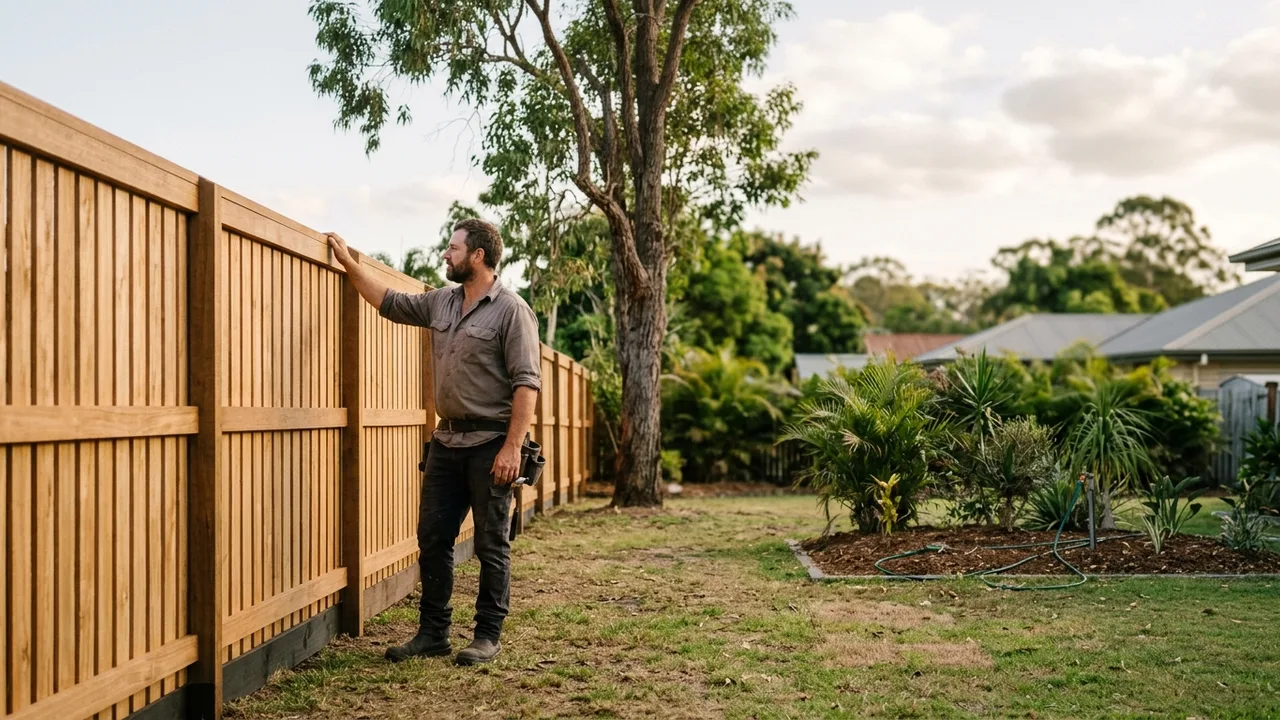
Timber Fencing in Coomera
Fence leaning and the posts gone soft at the base? Timber fencing in Coomera starts at the posts, because in clay that is where a rebuild has to begin.
A rebuilt timber fence lasts far longer when the posts are done properly, and most of that comes down to what goes into the ground. A fence that rocks or leans at ground level has usually lost its posts to moisture, and a local fencer confirms that on site. Rebuilt well, a timber paling or privacy fence gives you a straight, solid boundary again.
Timber fencing in Coomera: what a rebuild involves when posts rot
A fence that is rotting at the posts can be rebuilt to last, but replacing only the palings will not do it. The posts carry the whole fence. Once their bases go soft, every rail and paling above them is pulled out of line.
A proper rebuild starts by finding where the damage sits. Sometimes only a few posts have failed and the rails and palings can stay. Other times the whole run has weakened and a full replacement is the sounder choice.
The result you are after is a fence that stands straight, keeps the dog and kids in, and gives you privacy from the neighbours.
Why timber fences rot at the posts
Rot starts where timber meets the ground. Water sits against the post, the wood stays damp, and fungus slowly softens it from the base up. On sloping blocks around Upper Coomera, runoff after a summer storm collects at the post bases on the low side of the yard, and clay ground drains slowly, so the timber can stay wet for days.
A post that was set in soil alone, or in a hole that traps water, usually fails sooner than one set in concrete with good drainage. Timber that was never treated for ground contact fails sooner again.
The usual signs are a fence that rocks when pushed, palings that pull away from the rails, and a post you can dig a screwdriver into.
Treated pine or hardwood: which suits your fence?
Treated pine is the practical choice for many backyard fences. It takes paint or stain well, costs less upfront and is treated to resist termites and decay when it is the right grade for outdoor use.
Hardwood is denser and has a richer natural colour. It suits a fence you want to keep for a long time, and it is the usual pick for hardwood batten screens, where the timber stays on show.
Neither is termite-proof in the absolute sense. Treatment and good detailing lower the risk, and keeping timber off wet soil helps both.
How deep should the posts be set in clay soil?
Deeper posts and a drained base hold up better in clay. The fencer sets the depth for your block and fence height. Taller fences and sloping runs put more load on each post, so they need more in the ground.
Clay swells when wet and shrinks when dry. That can push a shallow post out of line. A layer of gravel under the post lets water drain away from the timber.
Concrete around the post locks it in place. It is left to cure before the rails take any weight.
Hardwood batten screens and paling styles
Paling fences give full privacy when the boards sit tight together. Lapped or butted palings, a capping rail and a bottom plinth are the usual ways to finish them neatly.
Batten screens work on gap width. Narrow gaps block most of the view while still letting some air through, and wider gaps pass more breeze and light but show more of the yard. Where you need total privacy, a solid paling fence is the better match.
Height limits and approval for a timber fence
Fences of 2 m or under are generally accepted development in Queensland, subject to siting rules. A fence over 2 m above natural ground needs building approval from a certifier. The fencer measures the run and the height, and the certifier makes the decision.
If the fence sits on a shared boundary, Queensland's dividing fence rules cover how the cost is shared with your neighbour. Plain talk over the fence usually makes this easier, and a written price gives both sides the same numbers.
What to ask when the fencer calls back
A good fencer gives you a written price before work begins and says what it covers. When the call comes, ask how the posts will be set, which timber grade will be used and whether removing the old fence is in the price.
When you are ready, put the fence type, the length and what stands there now in the message box.
How it works
-
Talk through the problem
Tell the fencer how long the run is, what stands there now and how the ground falls. That is enough to start planning.
-
Measure and price
The fencer measures the boundary, notes slopes and gates, and gives you a price before any post hole is dug.
-
Remove the old fence
Rotted posts, rails and palings come out, and the line is set out straight.
-
Set the posts
Posts are plumbed upright and fixed in concrete over a gravel base, then the rails and palings follow.
-
Finish neatly
Gates are hung, the palings are lined up evenly and the site is cleared of the old timber.
Scope in detail
- Timber paling fences The classic backyard boundary, built in treated pine or hardwood with a neat, even finish.
- Privacy fences Closer-set palings and added height within the rules give you screening from neighbours and the street.
- Hardwood batten screens Spaced hardwood battens give a modern look and soften a boundary or a feature wall.
- Old fence removal The leaning or rotted fence is pulled out so the new one starts from clean ground.
- Gates in timber Gates hung on solid, properly set posts stay square, so they swing freely and latch cleanly instead of dragging.
Timber Fencing options
- Replace rotted posts only Where the rails and palings are still sound, new posts go in and the existing timber is refixed.
- Rebuild the whole run When most post bases have softened, a full replacement gives one straight line instead of patches.
- Replace bottom palings and rails Worn palings at ground level and tired rails are swapped out while the posts stay.
- Reset gate and corner posts Posts that carry a swinging gate or the pull of two runs are set deeper so they stop leaning.
Timber Fencing across Coomera
Frequently Asked Questions
Is it worth fixing one rotten post, or will the whole timber fence need replacing?
How do I keep a timber fence sound through a Gold Coast wet season?
Do gate and corner posts need to be set deeper than the line posts?
Get it priced
Fence leaning, gate dragging or dog getting out? Get a local fencer onto the job.
Tell us what you need built and get a written quote.