
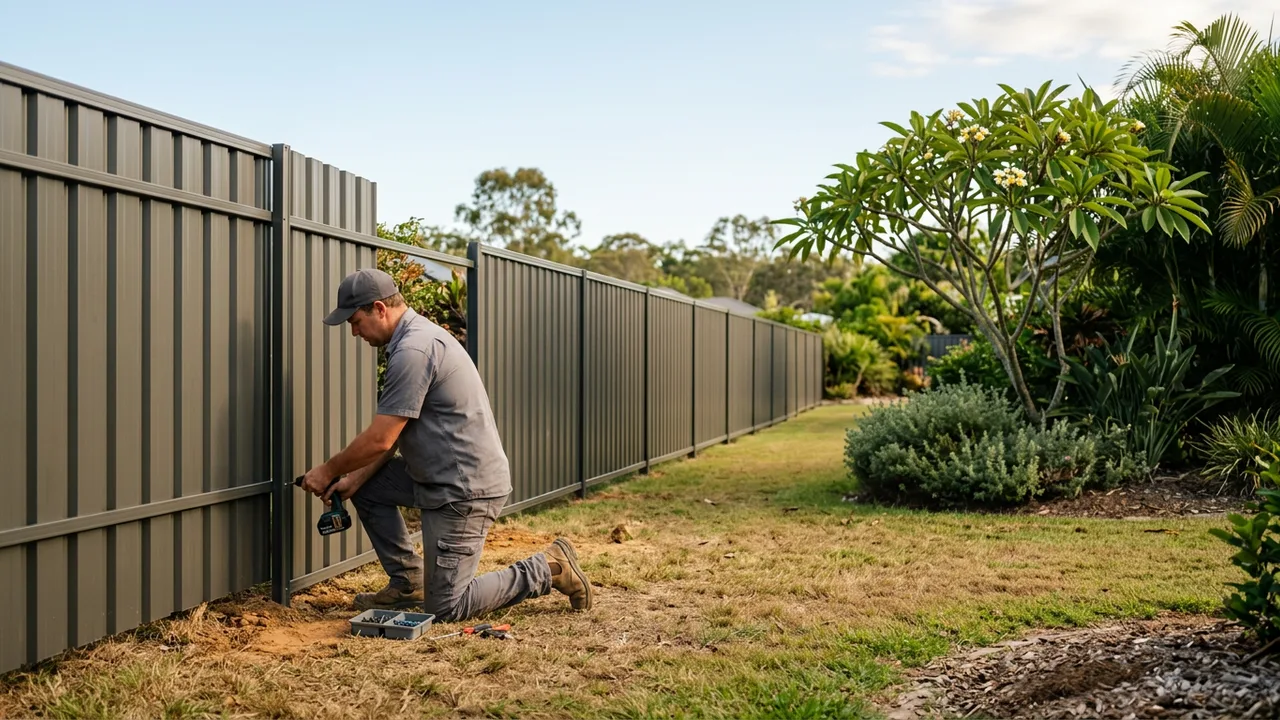
Colorbond Fencing in Coomera
Tired timber or a storm-flattened run? Colorbond fencing in Coomera gives you a solid, private boundary that will not rot or feed termites, with a written price before any work starts.
Yes, a Colorbond fence can stand up to storms and give you real privacy, provided the posts are set properly and the panels suit your block. It is steel sheeting made by BlueScope, fixed between posts and finished with capping along the top. It suits new estate boundaries, tired timber that needs replacing and fences that sit on a retaining wall.
Colorbond fencing in Coomera: why it holds up in a storm
A Colorbond fence is a solid steel wall along your boundary, so nobody sees into the yard from the street or the neighbour's side. That privacy is the main reason people choose it over lapped timber, where gaps open as boards dry and shrink.
Steel does not rot at the base and termites have nothing to eat. Around Coomera and the northern Gold Coast, wet season downpours and summer storms are what a boundary fence has to face, and steel removes the usual failure point of an old timber fence.
The panels are only as steady as what holds them. A solid sheet catches wind like a sail, so the posts and the footings carry the real load.
Concrete-set posts for clay soil and wet season wind
Posts set in concrete are what keep a Colorbond fence upright. The hole is dug to suit the ground, the post is plumbed straight and the concrete locks it in place.
Clay soil swells when wet and shrinks when dry, and fill behaves differently under a footing again. Across the northern Gold Coast, clay and sloping ground both bear on a boundary fence. Where a retaining wall runs along the high side, the fencer checks whether each post lands in natural clay or placed fill. The hole and concrete are then sized to suit.
Replacing an old fence on the same line
Old fence removal is part of a replacement job, and it belongs in the written price. The quote should say who takes the old timber away and whether old posts are dug out or cut off.
If the old fence is a dividing fence shared with a neighbour, the cost conversation is separate from the build. The fencer can give you the measurements and a price to work from.
Colorbond fences on retaining walls
A Colorbond fence can sit on top of a retaining wall. The catch is height. Queensland treats the wall and the fence as one structure. Once the two together rise past 2.0 m from natural ground level, you will usually need building approval or a siting decision.
That decision belongs to a building certifier, or council for planning matters, never to the fencer. What the fencer does is measure the wall, the ground level and the proposed panel height.
If your wall is already tall, a lower fence on top or a different layout may keep the total under the line.
Gates and finishing details
A gate that drags or will not latch is usually a sign of a post that has moved or a frame hung out of square. Setting gate posts plumb in concrete prevents most of that.
Swing gates suit most side access. Sliding gates suit tight spots where a swing would hit a car or a garden bed.
Capping closes the open top edge, sheds rain and gives the run a neat, even finish.
What a written quote and QBCC licence should show
A good quote names the length of fence, the height, the colour, every corner and gate, the old fence removal and the capping.
A QBCC licence is held by the individual or company doing the work, so it is fair to ask who that is. Warranty terms should be in writing, with the period and what is covered stated plainly.
Colorbond or timber for your boundary?
Colorbond costs more up front than basic timber in many cases, but it asks very little of you afterwards. Timber needs staining or sealing and can lean, rot at the posts or let termites in over time.
Timber still suits some yards. It gives a warmer look, and it can be easier to match to an existing neighbour's fence.
How it works
-
Measure the run and read the slope
The fencer walks your boundary and notes how the ground falls. That step pattern decides where each post lands. Where a retaining wall runs along the high side, its height is measured too.
-
Get a price first
The written price is worked out from the measured run. It also says how the fencer handles the post holes if they hit clay or fill.
-
Remove the old fence
Rotted palings, broken sheeting and loose posts come out so the new line sits on solid ground.
-
Set the posts in concrete
Each post is plumbed and locked into concrete, then left to cure before panels go on, because the panels pass their wind load down into the posts.
-
Fix panels, capping and gates
Panels are fixed between the posts and capping goes along the top. Gates are hung last and adjusted until they swing or slide freely and latch.
Scope in detail
- Stepped panels on slopes Steel panels stay level, so the run drops in steps at the posts. A steeper lot means bigger steps and a larger gap under the lower edge of each panel.
- Panel height The height you pick changes privacy and wind load, and it decides how the fence sits against a neighbour's fence or a retaining wall.
- Corners and gate openings Each corner and gate opening adds posts and changes how many panels the run needs.
- Capping Capping is usually matched to the panel colour and stiffens the top edge of the sheet along a long run.
Colorbond Fencing options
- New and replacement fences Full steel runs for open estate yards, or old timber taken out and a straight fence built on the same line.
- Matching gates Swing and sliding gates in the same steel, hung to latch cleanly.
Colorbond Fencing across Coomera
Frequently Asked Questions
How far apart should Colorbond fence posts be?
How do I calculate the number of Colorbond fence panels I need?
What does a Colorbond fencing warranty cover?
Get it priced
Fence leaning, gate dragging or dog getting out? Get a local fencer onto the job.
Tell us what you need built and get a written quote.