
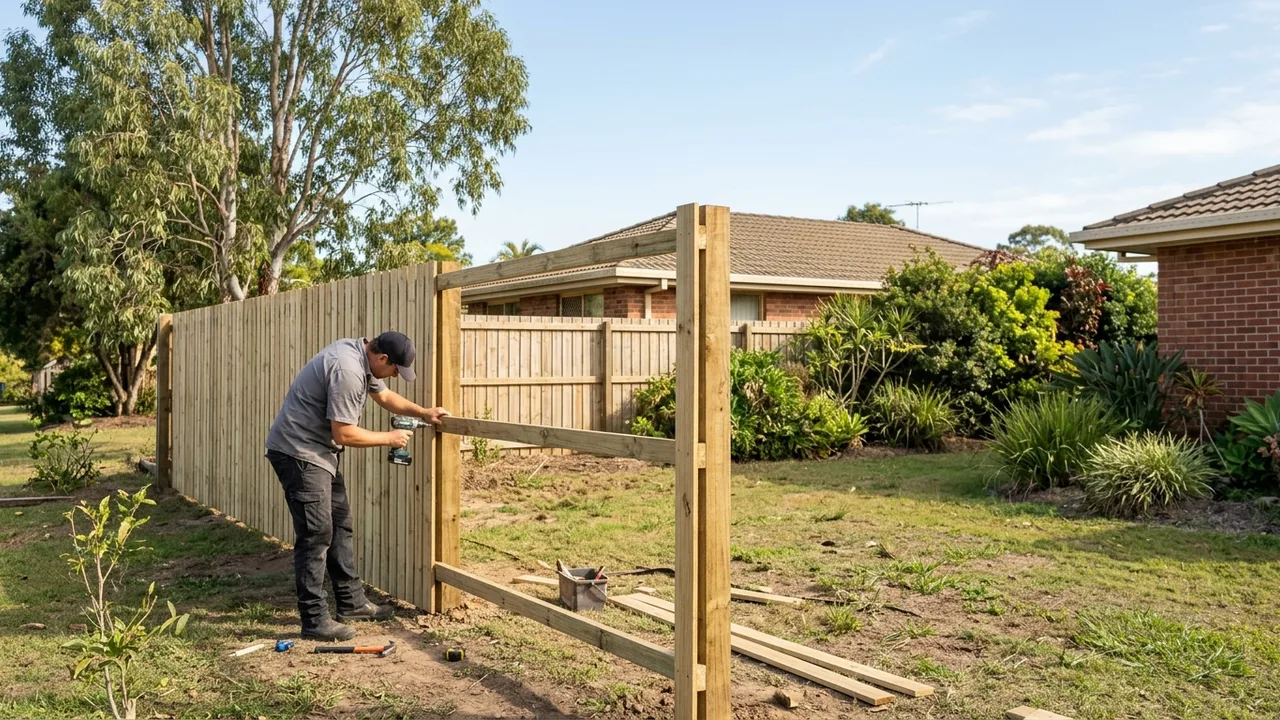
Coomera Fencing in Pacific Pines
Fencing in Pacific Pines gets stuck when a shared fence leans and the neighbours disagree on cost. A clear price from a local fencer gives you a place to start.
A local fencer measures the boundary and gives you one written price, and can include removing the old panels if you need that. One written price gives both neighbours the same figure to discuss, which often makes the cost conversation easier. If a storm has dropped a run, the fencer checks whether the posts can stay before pricing new panels.
Fencing in Pacific Pines: shared fences, boundaries and gates
Most Pacific Pines fence jobs start with an estate-era fence that has stopped doing its job. Panels lean, posts rot at ground level, or a gate drags on the path and will not latch. A fencer looks at the posts first, because the posts decide whether the rest of the fence can be saved or needs to come out.
Estate fences went up at around the same time, so when one section fails the rest of the line is usually close behind. Pricing the whole run at once saves paying for a second visit next year.
A good outcome is a fence that stands straight, keeps the kids and the dog in, gives you privacy and arrives with a price agreed before the first post hole is dug.
Sharing a fence with your neighbour: who sorts it out?
Both sides of a dividing fence have a stake in it, so the cost is talked through between neighbours. Queensland's Neighbourhood Disputes (Dividing Fences and Trees) Act 2011 holds the rules on who pays. A fencer cannot decide that for you, but the written quote does more work than it looks. In Queensland, a formal notice asking a neighbour to contribute includes a written quote, so having one early saves a step if talks stall.
A garden bed or retaining wall hard against the old fence changes how the new one goes in, because the posts need solid ground beside them. Pulling out an old timber fence also adds removal and disposal to the job, which a swap of one new fence for another does not.
Which fence suits a cul-de-sac home?
Along the M1 side of Pacific Pines, Colorbond's solid sheet blocks more traffic noise than gapped timber palings. For a fence facing a reserve or the forest edge, timber tends to sit more naturally against the bushland, though it needs sealing or painting to stay sound. PVC and composite panels resist rot and need little care.
Cul-de-sac homes often have short front boundaries and wide, odd-shaped backyards. That affects how many panels and posts the job needs, and where a gate can swing without clipping a garden bed. A fencer who walks the boundary will see these things quickly and price them in.
For a block with a dog that digs, a fence with a clean bottom edge or a small kickboard stops the gap that lets animals slip out.
Posts that hold in wet clay and summer storms
Posts hold when they are set deep enough and fixed solidly. Concrete-set posts are the usual method here, because wet clay moves and a post sitting loose in it will lean within a season or two. The fencer sets the depth to suit the fence height and the ground on your boundary.
Sloping blocks need extra thought. A fence on a fall is stepped or raked so the panels follow the ground without leaving big gaps underneath. Heavy rain can soften the ground around old posts, which is why a storm so often knocks down a fence that was already weak at the base.
When a storm drops panels across your yard, the fencer can usually tell on site whether the posts are still sound or whether the whole run needs replacing.
Pool fences that pass inspection and gates that latch
A pool fence is a safety barrier, so the gate, the fence height and the gaps all matter. A garden bed, planter or retaining wall close to the fence matters as much as the panels, because anything a child could climb weakens the barrier. Queensland has its own pool safety rules, and a licensed pool safety inspector checks whether the barrier complies. The fencer builds to those rules and measures the barrier so the inspector has what they need.
Side gates are the other everyday problem. A gate that drags is often a sagging post or a hinge that has pulled loose, and the fencer confirms the cause on site. Sliding gates suit tight driveways, while swing gates suit a clear path beside the house.
Coomera fencing across Pacific Pines streets, parks and the forest edge
Pacific Pines was planned as a master-planned estate, with house lots laid out and open-space reserves set between the streets.
The streets curl into loops and short dead-end courts, with parks and green pockets set among the houses. Homes near Penrhyn Street Reserve, Moorea Court Reserve, Cope Place Reserve or Flooded Gum Park may back onto open space, where a fence faces the park rather than a neighbour. Others sit close to Park Lake State School, where a solid fence gives welcome privacy from foot traffic.
The suburb lies between the Pacific Motorway (M1) and the Nerang State Forest. Bushland on one side and the motorway on the other means some boundaries benefit from a taller, solid screen that softens noise and sightlines.
Services in Pacific Pines
- PVC and Composite Fencing Low upkeep PVC and composite fences in privacy, picket and Hamptons styles for local yards.
- Gates and Automatic Gates Swing, sliding, pedestrian and automatic gates fitted to match your fence, from side paths to driveways.
- Rural Fencing Wire, star picket and galvanised pipe fencing for acreage blocks, paddocks and horse properties.
- Colorbond Fencing Steel boundary fences with concrete-set posts, capping and matching gates for privacy on estate blocks.
- Timber Fencing Treated pine and hardwood paling fences, from replacing rotted bottom palings to rebuilding the whole run.
- Pool Fencing Glass and tubular pool fences, gates and repairs, built to Queensland pool safety rules for your yard.
Frequently Asked Questions
Who pays for a dividing fence in Pacific Pines under Queensland's dividing fence laws?
Get it priced
Fence leaning, gate dragging or dog getting out? Get a local fencer onto the job.
Tell us what you need built and get a written quote.