
Pool Fencing Coomera: Glass and Tubular Barriers Built to Queensland Rules
Pool finished but not fenced, or an inspector's fault list in hand? Pool fencing in Coomera, in glass or tubular, is built by a local fencer to Queensland pool safety rules.
The gate, the latch and the posts matter as much as the panels on a pool barrier, whether it is glass or tubular aluminium. A finished pool with no barrier is a risk to small children, and the fence is often the last job standing between you and the first swim.
Pool fencing in Coomera: what makes a barrier pass on local blocks
Pool barrier rules come down to a few measurements. Queensland's rules sit under the Building Act 1975 and use AS 1926.1 as modified by Queensland Development Code MP 3.4. The QBCC publishes the detail.
The barrier needs a height of at least 1200 mm above finished ground, with bottom gaps no wider than 100 mm. A non-climbable zone must stay free of rails, planters and footholds, and its size depends on the fence design. Gates must close and latch by themselves. An outside latch release sits 1500 mm or higher off the ground, while a shielded latch on the inside of the barrier may sit lower.
On sloping or filled lots, the ground beside a pool can step or settle. Where thin paving sits over soft, wet ground, the base needs a look. A panel that reaches full height on a level paver can fall short where the ground drops away, so a fencer who builds pool barriers measures your layout against these rules before quoting.
Glass or tubular: which pool fence suits your yard
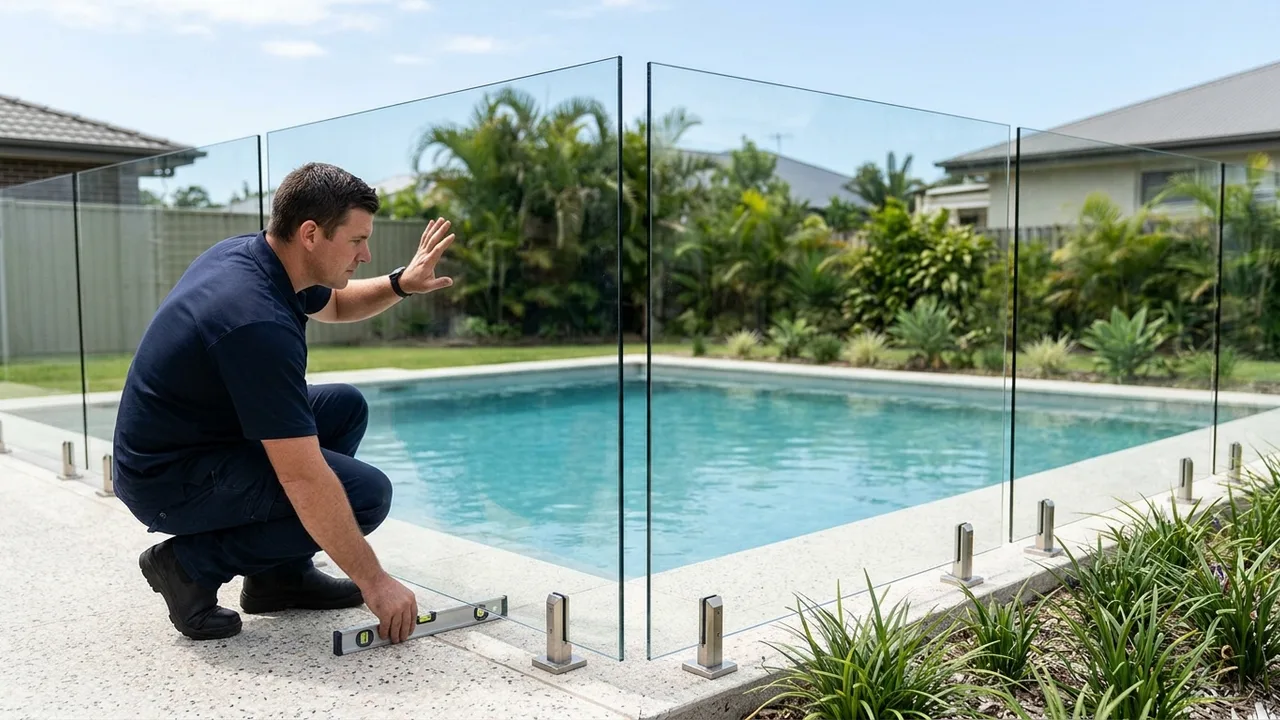
Frameless glass gives the clearest view of the water and of the kids in it. The panels are held at the base by stainless spigots or a channel, with no top rail, so nothing breaks the line of sight from the deck. Semi-frameless glass adds slim posts between panels, which keeps each pane a workable size on a long side.
Tubular aluminium is a slimmer, more solid look. Its vertical bars are spaced to meet the gap limit, and the panels can step or rake with the ground. It needs only a rinse now and then, while glass shows water spots and wants regular wiping.
Glass balustrades on a deck beside the pool are quoted separately.
Pool gates and latches that close every time
The gate is used every time anyone walks out to the pool. It has to close and latch on its own, with the release placed out of reach of small children.
A gate that drags on pavers or sags on tired hinges stops latching, and that undermines the whole barrier even when every panel is sound.
Concrete-set posts for clay soil and wet season storms
Clay swells when it is soaked and shrinks as it dries, and that movement works shallow footings loose. On a new estate lot where the ground was cut or filled before the pool went in, posts need holes deep enough to reach firm soil and concrete bases sized to the post.
Glass spigots are fixed into concrete or core drilled into a solid slab. Thin paving laid over sand cannot hold them, so the fencer looks at what sits under the surface first.
Pool safety certificates when you sell or lease
A pool safety certificate is issued by a licensed pool safety inspector, not by the fencer. It stays valid for 2 years on a non-shared pool and 1 year on a shared pool. One is required when you sell or lease a property with a pool, so a failed barrier can hold up a contract.
When an inspection lists faults, they usually come down to a gap, a latch or something climbable near the fence. Whether a pool needs building approval is a decision for a building certifier or council.
Fixing pool fence posts on pavers, thin slabs and sloping lots
Where pavers run right to the pool edge, the fencer cuts or drills them for spigots. Where the slab edge is thin, a base channel may suit better. On a lot that falls away, tubular sections stepped down the slope keep the height and gaps in range.
Pool still waiting on its barrier, or an inspector's fault list to clear? Type in how long the run is, where the pool sits, what stands there now and how the ground falls, then use Send My Fence Enquiry.
How it works
-
Measure the pool area
On site, the fencer walks the boundary and notes the pool position, the fall of the ground and anything a child could climb near the fence, such as planters, rails or a retaining wall.
-
Choose the fence type and get a quote
Glass and tubular options are priced on the same layout, and the quote sets out the fence type, the length, the gate and what comes out.
-
Remove any old fence and set the posts
Any old barrier is pulled out and new posts or spigots go into concrete or sound slab, sized to suit your soil.
-
Fit panels, gate and latch
Panels and the gate go in, and the fencer checks the height, the bottom gaps and the latch release before calling it finished.
-
Ready for the inspector
With the barrier finished, a licensed pool safety inspector can assess it for a certificate.
Scope in detail
- Non-climbable zone kept clear Planters, rails and retaining walls near the fence are noted, because a child can use them as a foothold.
- Height and gaps built to the rules Barrier height, bottom gaps and latch release height are set out to suit the pool inspector's measurements.
- Removal of an old or failed barrier where there is one Rusted or leaning sections come out so the new posts sit on solid footings.
- Gate posts set deeper than panel posts The gate's swing loads its post every day, so it gets a larger footing than the panels beside it.
Pool Fencing options
- Frameless glass pool fences Toughened glass held by spigots or a base channel. Channel mounting can suit a thin slab edge, while spigots suit solid concrete.
- Semi-frameless glass pool fences Panel widths are planned around corners, the gate opening and the pool edge so the glass sits evenly between posts.
- Tubular aluminium pool fences Powder coated finish in a choice of colours, with sections that step or rake down a sloping lot.
- Pool gates and latches Self-closing hinges and a latch that holds its adjustment, so the gate shuts itself every time.
- Pool fence repairs Re-setting a loose post, replacing a cracked pane or swapping worn hinges so an existing barrier is back in order.
Pool Fencing across Coomera
Frequently Asked Questions
How long does a pool fence take to install?
How do I know if my pool fence needs a fencer to look at it?
What does a pool fencing warranty cover?
Get it priced
Fence leaning, gate dragging or dog getting out? Get a local fencer onto the job.
Tell us what you need built and get a written quote.